This is fair warning. As a famous oversized rapper once said, “it’s about to get ugly.”
It’s 2009 and the controversy lives on – the proper or improper use of a certain word. Who will be “allowed” to use the N-word and who won’t? The simplistic argument usually goes like this –“Why is it okay for Black rappers and comedians to use the N-Word and not okay for White people to say it?” “C’mon, it’s just a word. What difference does it make?”
But let’s be real. Everyone, even the densest of commentators suspects why the word is not for use in polite conversation. It has a complex history and despite all attempts to change it from an incredible ugly insult to a common everyday descriptive has failed. The word is a nexus for a number of sensitive issues – censorship, American history, power, and much more. It embodies issues that many Americans don’t ever want to think about, let alone talk over or deal with.
Well, if we can’t use it in conversation, how about the appearance of the N-word in comic books? Surely there couldn’t be a problem with the use of racial pejoratives in this fun filled, happy medium? Well, not exactly. READ MORE...
You may wonder how things were done in the so-called innocent, white bread, and censor-prone days of yore. You’d be surprised. In the 1940s, a series of comic books was created to encourage young people to read classic literature. Back then, maintaining the integrity of the original work, albeit with the added incentive of graphic images, was considered important by both publishers and educators. Classic Illustrated Comics didn’t flinch to use the historically accurate N-Word. The works of Samuel Clements -- Huckleberry Finn, Tom Sawyer, Pudd’Nhead Wilson -- all still proudly carried the currently denounced word. Even the “Narrative of Fredrick Douglass” and Harriet Beecher Stowe’s “Uncle Tom’s Cabin” didn’t expunge it. And while these comics are still available and the original tomes are required reading in schools and colleges across the country, the appearance of the N-Word in contemporary classrooms is not always tolerated without heated debate or the very real threat of censorship.
Back in the wild and radical 1960s and 70s, there emerged a new crop of young radical artists and writers. They seemed hell-bent on being as controversial, edgy, and offensive as possible Even in the heyday of underground comics, the N-word was rarely used. Apparently there was line that even the most rabid revisionist wouldn’t cross.
In 1997, Acclaim Comics’ great but under-appreciated series, Quantum and Woody, tried a unique approach to the N-word. They featured a story in issue #4 where the N-word was replaced with the word “noogie.” It expertly made fun of the controversy and is one of the funniest comic stories I ever read, but hey, I have a sense of humor. If you get a chance, pick up a copy of this issue – it still holds up.
But enough talk of the distant past. How do current comic books really fair in this race to control what we say, think and print? A few years back Marvel Comics’ reinvented title, Black Panther, weathered an appearance of the expression, “work like an N-word” (used by a white character, mind you) even though there were a storm of angry letters and much public debate. Four years ago their Max Comics line showcased the word, in their Supreme Power: Nighthawk book (about a very severe Black vigilante super guy) albeit as racist graffiti. In 2007 the Black character Barracuda, the character in The Punisher Presents: Barracuda use the supposedly least offensive version (“nigga”) to open and close the first issue. I guess I should also mention that Barracuda is not exactly a role model for anyone with his use of all kinds of obscene language, gratuitous violence, and public urination.
The popular current series Loveless by Vertigo (DC Comics’ “adult” line) is about the fictional lives of Americans just after the Civil War. This historically accurate comic book uses the N-word in its narrative regularly. It seems despite any number of censorship watchdogs that at least one main stream comic publisher is resisting the current trend to re-write history, even as fiction.
As an artist, a historian, and an educator I see this discussion, heated or otherwise, as something that must take place. And while I don’t see it being resolved anytime in the near future, current presidential race notwithstanding, we have to have it. We need a measured, in-depth, all parties listening and thinking creatively discussion. I understand parents (Black and White) making choices about how they want the N-word used or not around their children. But I also think that wishing it away is a bit unrealistic as well. Talking about the N-word does not make you racist, but not talking about it could well keep you ignorant.
Now if you find you have an appetite for more, I recommend you check out a segment on YouTube that has been widely traded around the internet. It features Motown Maven William “Smokey” Robinson giving his own eloquent response to words that are used to negatively describe Black people. Comics, conversation or whatever, I don’t think anyone could have done a better job.
And the struggle for control of our thoughts and language continues.
The currently running 3-D animated Iron Man series called Iron Man: Armored Adventures has been a mixed bag for me. On one hand it's so far out of continuity that it gives me a headache not to mention that Tony Stark is a high school kid. On the other hand the series looks good and the re-imagination of the traditional characters is interesting.
Anyway next season we finally get a Black Superhero in the mix and it's not War Machine (though I think it ought to be). It's the Black Panther. Here's a taste:
The Falcon (Sam "Snap" Wilson) is a Marvel Comics character that has been pretty much every kind of token African American character needed. He's been the angry Black man, the near powerless street fighter, and the token sidekick. He's been forced onto the Avengers super team because of their lack of minority members. Can anyone say Affirmative Action? He's even worked for the mob and been a pimp but that was all before he met Captain America.
Sam was brainwashed and planted for Captain America to find and befriend by the Red Skull. After that, he took the name Falcon and spent his time between the cleaning up the streets of Harlem and playing attache to Captain America. Through the relationship with Captain America, he went on to playing a bigger role in the heroic community including joining America's premier superteam, the Avengers, and working with S.H.I.E.L.D. on many occasions. Because he was brainwashed into becoming a good guy, the memories of his former life have come to the surface more than once but he remains a hero in good standing.
His abilities are that of an highly trained, gymnastic athlete with two exceptions. He has the ability to mentally communicate with birds, a bond that is strongest with his bird companion Redwing. He also has a complicated retractable flying apparatus that provides him with a variety of aerial combat capabilities besides just flying. The latest set was provided by fellow hero and benefactor, the Black Panther.
This character has little obvious impact on the Marvel Comicbook Universe but he has been around since late 1969. He is trustyworthy, caring, and quite heroic but ultimately uninteresting. His abilities are limited but I guess flight added to the ability to kick ass is enough. Considering the era this character was introduced credit does have to be given to the fact that he has stood the test of time. There are action figures of his likeness out there and he even made it to the Marvel animated universe during the short-lived Avengers: United They Stand animated series. Here's a look:
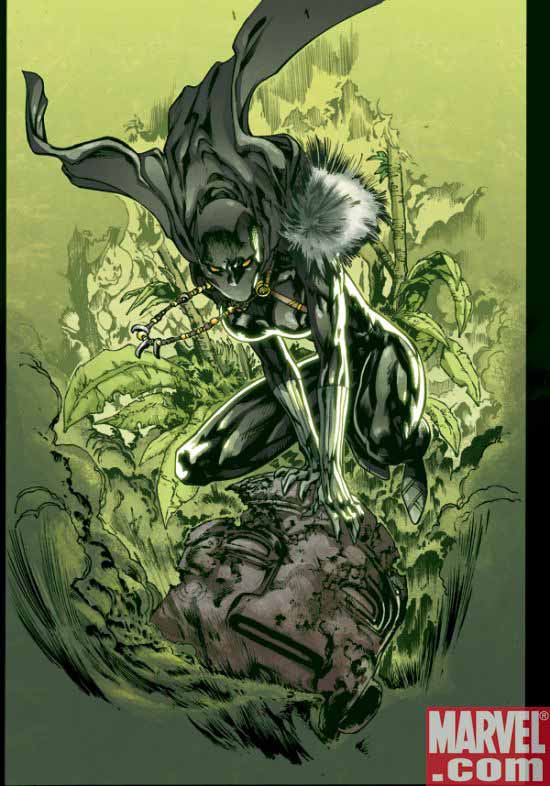
Be on the lookout for the all-new, female, Black Panther. What happened to the other guy? I have no idea but this new version debuts in February and the story will be written by Reginald Hudlin who's done great work with the Black Panther in the past. Is the world ready for a female Black Panther? Is this a gimmick? Want to know more? Take a gander at the interview. Maybe the original Black Panther wants to spend more time with his wife and let his sister take a spin in the tights. Time will tell and I'm looking forward to it. The Black Panther is the premier Black Superhero so expanding his portion of the Marvel Comics universe can only be a good thing.
Finally the Black Panther comes to the screen brought to you by Reginald Hudlin and Denys Cowan. I've always felt that this was the only Black superhero that rightfully had the prefix "Black" in the name. He seemed, and still does, to be perhaps the most positive representation of Black people in comics. That's why I'm more than a bit amazed that this is coming out of BET. I haven't had a reason to watch that network in years due to lack of positive programming. The first look at the animation is great and disappointing at the same time. It's a step up from Flash animation but not to the level of the Batman animated series. Regardless, it still looks great and I am very excited that this is finally happening. Maybe it will pave the way for a live action movie, hopefully with someone other than Wesley Snipes. Take a look at the the attached videos. The first is a sample of the show. The second is an introduction to the show by its creaters and the last is an interview with the people who are bringing it to the small screen. Enjoy!